Showing posts with label Photographs. Show all posts

Saturday, 8 April 2017

Tree Down

On February 23rd, storm Doris swept across England.  Although the centre of the storm passed across northern England and Scotland, the winds in the south of the country were still strong enough to cause considerable damage. In Milton Country Park, a number of trees, mostly the older ivy encrusted willow trees on the eastern edge of Dickerson's Pit, were either uprooted or broken in two.

Root ball of fallen tree
The root ball of fallen trees always seem improbably small.

The park was closed on the day of the storm, and by the time it reopened the following day, all the paths had been cleared of fallen trees.  All the photographs in this post were taken on either February 24 or 26.

Willow tree with trunk snapped in two just above ground level
Willow tree snapped in two.

The root ball of a felled tree always seems impossibly small for the size of the tree above the ground.  The diameter of the roots is far less than I would expect, and there is no long tap root burying deep into the ground.  Yet the leverage exerted by the trunk and crown swaying in even a moderate wind must be quite immense, and, one could well imagine, far too much for such a small anchor.  All those thousands of little roots must effectively stitch the tree into the ground.

Trunk split as if by an axe
Close of fracture gives some idea of the forces involved.

But, even more impressive, are the forces that must be involved to break the trunk of a tree in two, splitting what appears to be quite solid wood in two as cleanly as if cleaved by an axe.  

Fallen tree seen from root end with trunk sawn off at the path
There's a certain sadness about a fallen tree.

The woodland trust are quite clear that ivy does not kill or harm its host.  However, I wonder if the presence of a heavy growth of ivy on a tree in anyway increases its chances of being blown over in a high wind.  The ivy must increase the wind resistance of the tree, which together with the weight of the ivy, must put an extra strain on the root system.  On the other hand, the thick ivy tendrils surrounding the trunk, grounded in their own independent root system, could be acting as guy ropes and actually help to stabilise the system.

Large heap of branches and ivy beside path covered in sawdust
Ivied crown heaped up beside the path

I found the sight of the remains of a once mighty tree lying on the ground quite sad.  On one side of the path was a heap of what appeared to be ivy, but the sawn ends of branches showed it was the canopy of the fallen tree.  On the other side of the path, was a line of  neatly sawn sections of its trunk, which seemed to me to be like chapters of a biography - a life parcelled out into manageable sections and lifeless.  

Four sections of the trunk in a row
The trunk of the tree sawn into neat sections.
However, in time, the wood will become an active biosystem, and provide a home and food for insect larvae and fungi; and, a surface for moss and other small plants to grow on.

Next: March 2017


Saturday, 25 March 2017

Winter

January, February 2017.  Winter 2017.  Still no snow.  For two years now, I have been photographing Milton Country Park, and in that time we have had no snow at all.  Unless, that is, you count a flurry of snowflakes in the wind that did not settle and quickly turned to sleet.  But at least this year, we had a spell of bright frosty weather, enough to freeze the water in the pits.

Block of ice sitting on top of frozen water of the pit
Ice on Dickerson's Pit - 24 January 2017
The ice near the shore is richly textured
A texture that is subtely altered around the white lump of ice.

Why do people feel compelled to throw things on the ice?  No sooner had the ice appeared, then stones, logs, branches, balls, and general rubbish littered the frozen surface.  It is as if the sight of its smooth white surface was too much for mortal eyes and had to be covered up.  But as my first photograph shows, the surface of the ice close to the shore is richly textured, even without the debris.


Bare branches of trees in orchard covered in rime
Frosty Orchard - 22 January 2017
Almost the only time I have successfully photographed the orchard.

The same cold spell produced a couple of mornings when conditions were right to cover not only the low growing vegetation, but also the branches of at least some of the trees with rime.

View over Dickerson's Pit, with bare trees and golden reeds
Dickerson's Pit - 14 February 2017
A scene that could easily have been taken three months earlier
but not three months later when leaves on the bushes in the foreground
will completely obscure the view.

Apart from the frost, little has changed over the last couple of months.  The changes that have happened are the gradual growth of plants such as cow parsley, comfrey and nettles.  But this new growth is only a couple of inches high, and make almost no impact on the appearance of the park.

White fluffy clematis fruit catching sun amongst bare branches
Clematis Fruit - 24 January 2017
Fluffy white balls catching the light

Far more apparent are the fluffy white clematis fruit which are still in abundance on the climber, and very noticeable when they catch the low sun.

Small group of snowdrops growing amongst trees
Snowdrops - 19 February 2017
A typical scene in the woods in the park
with an isolated clump of snowdrops growing amongst the trees.

During February, the snowdrops finally blossomed, probably at least a month later than last year.  The name 'snowdrop' refers to the large pendants or drops that were worn by ladies in the sixteenth century either as earrings or on brooches.  I was surprised to find that alternative names for these flowers include death's tear; and that the only folk lore surrounding them is that it is unlucky to take them indoors.

Conversely, snowdrops are seen as a symbol of hope.  One legend has it, that after Adam and Eve were evicted from the garden of Eden, Eve became depressed with the apparently endless  cold wintry weather.  To cheer her up, an angel appeared and changed some of the snowflakes into flowers, as a sign that the dreary weather would eventually cease.

Wooden jetty backed by gold and orange willow trees
Jetty - 26 February 2017
The willows are probably even more colourful in February
than they were in the autumn - their yellowing leaves drab
compared to their branches at the end of winter.

A far more earthly sign of the imminence of spring is the gold and orange colours of the willow branches at this time of year.

Next: Tree Down 

Saturday, 11 March 2017

Sprat-Weather

Sprat-weather - fisherman's slang for those dark depressing days of late autumn and early winter when it never seems to get properly light. It seems such weather is good for catching sprats; perhaps the fish suffer from SAD and lose the will to live. On that basis, December should have been an exceptional month for sprat fishing. Almost every day was damp, and gloomy with a biting cold wind penetrating the thickest of coats.


Glimpse of sun through break in clouds reflected in dark muddy water
Dark Days - 13 December 2016
Sun reflecting in a muddy inlet off Dickerson's Pit

For me, this first image captures the mood of the whole depressing spell, a dark muddy patch of water reflecting a small rare glimpse of the sun. 


An oak leaf stuck in the grooves of a white frosty table top
Frosty Cheer - 8 November 2016
The frost provides little more than a white backdrop to the colourful leaf 

Enough of the gloom and a whole lot more cheerful picture! It has not all been grey murk. There have been spells of bright frosty weather, although there have been none of those gloriously pretty winter mornings when all the trees are covered in rime. At most, only the table tops, the grass and the low growing vegetation in the more open parts of the park have been covered in rime. This picture was taken on the first frosty day of the season at the beginning of November.  The brightness of such sunny mornings more than make up for the cold.


Moss on a Precipice - 8 November 2016
Again the frost brightens up the picture

I love the way a photograph can remove any sense of scale, and literally make a mountain out of a molehill (or vice versa). In this case, the moss growing on one of the planks of a table top is left teetering on the edge of a precipice.


Frost Candyfloss - 5 December 2016
The brown of the dead grass at the base of the plant, and
the colour of the trees in the background, underline how little
was affected by the frost.
A further brief frosty spell at the beginning of December, painted the grass and low growing vegetation with a veneer of ice, and left this plant looking like a stick of white candy floss.

Close up of sprays of winter jasmine
Winter Jasmine in the Sensory Garden - 2 January 2017
This winter jasmine climbs over the gate to the sensory garden
With most of the trees now bare, the only bright colours in the park were to be found in the garden. The bright yellow of the winter jasmine climbing over the gateway to the sensory garden bringing some much needed good cheer to the day.


Small dogwood bush, red and yellow surrounded by copper beech hedges
Dogwood - 2 January 2017
The bright yellow and reds of the dogwood,
eclipse the copper beech

In the garden opposite, the dogwood stood out brightly against the dull copper of the beech hedge and very muted greens and browns of the bushes and trees behind. 

Next: Winter  


Saturday, 25 February 2017

A Foggy Day

February 5 was the first seriously foggy day we have had for many months.  Although the fog did not penetrate the woody areas of Milton Country Park, it was sufficiently thick to obscure the opposite banks of the major pits in the park.
 
View down jetty into the mist with trees on opposite bank only visible as a slightly darker shade of grey
Jetty - 5 February 2017
The trees on the opposite bank are barely visible


Fog is a thief of vision.  It drains the landscape of colour and detail, leaving only the vaguest of details looming in the grey light.  I notice that the dictionary definition of loom is to appear indistinct and in an enlarged form.  Is this because the eye has nothing else to fix on in the monotonous gloom, and fills the space with anything it can discern? 

Bridge between thick bushes loom darkly in the mist
View of a Bridge - 5 February 2017
One of the bridges between Deep Water and Dickerson's Pit


The photograph above and the one below were both taken from the end of the jetty looking towards Deep Water. 


Dead reeds in foreground with large trees in fog behind
Dickerson's Pit - 5 February 2017

In this second image, there is a hint of colour in the reeds in the foreground. 


Vaguely discernible in fog, a cormorant on a branch with gulls in the background
Birds in the Mist - 5 February 2017
Cormorant on island in middle of Dickerson's Pit

Loom has connotations of menace.  The featureless landscape becomes disorientating, and the silence, so often a feature of thick fog without any wind, can be disconcerting.   The smallest sound is magnified - a bird's warning cry becomes a siren, as the mind invents what it can't detect.   

What I hadn't appreciated before is how white objects appear so luminous in the gloom. In the middle of Dickerson's Pit, between the end of the jetty and the opposite shore, there are a couple of small islands.  Even with some image intensification, this cormorant on a branch on one of these islands, is only just discernible. In contrast, the white gulls behind seem to positively glow.


View down Dickerson's Pit, with reed beds in the foreground, bushes and islands in the backgrouond.
Looking South Down Dickerson's Pit - 5 February 2017

Moving around, this photograph is a long view down Dickerson's Pit. Like the previous image, the swan and the white gulls stand out in the gloom.


One large brown reed and two small ones in water with nothing else visible.
Reeds - 5 February 2017

To an extent, fog is the photographer's friend: in blanketting out anything except the foreground, it can leave the subject of the picture isolated against a background of studio simplicity.  

Next: Sprat-Weather 


Saturday, 10 December 2016

Autumn Leaves 2016

Yellow and red poplar leaves covering the ground
Poplar Leaves - 2 November 2016
When on the tree, the yellow and red leaves would have been admired;
on the ground, the range of colours is actually increased.

We all admire the brilliantly coloured leaves of autumn while they are still on the tree. But when they fall off the tree, onto the ground, our attitude changes; their beauty is forgotten and we see them only as a nuisance. They make our streets and gardens untidy; they block the drains; and, they form a slippery layer on the railway lines, stopping the trains running to time. All that is left is to collect them up, and either burn them or put them in the rubbish; except for gardeners, who use the dead leaves for compost.
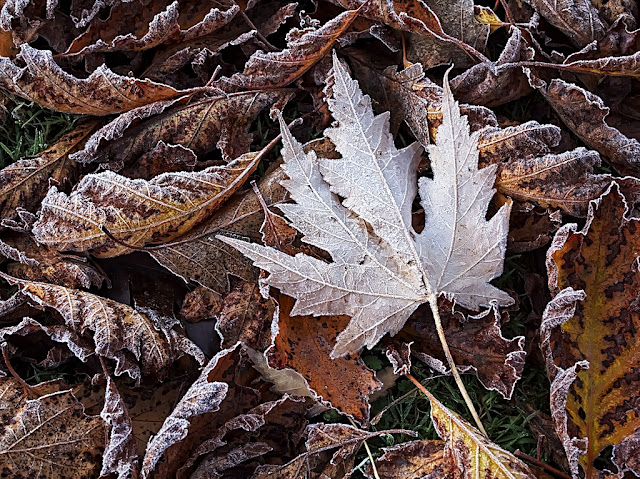
Light maple leaf lying on contrasting rich brown oak leaves
Contrasting Leaves - 8 November 2016
The maple leaf contrasts strongly with the surrounding oak leaves
in colour, shape and texture.

But there is still plenty of visual interest in the leaves as they rot away on the ground.  While the vibrant colours remain for a few days at least after the leaves have fallen, the range of colours is increased, not only by browns, dark purples, and blacks of the decomposing leaves, but also by different coloured leaves from adjacent trees.  Similarly, there are strong contrasts in shape and texture when a leaf from one tree falls on the leaves from a different type of tree.


Why Leaves Turn Red and Yellow
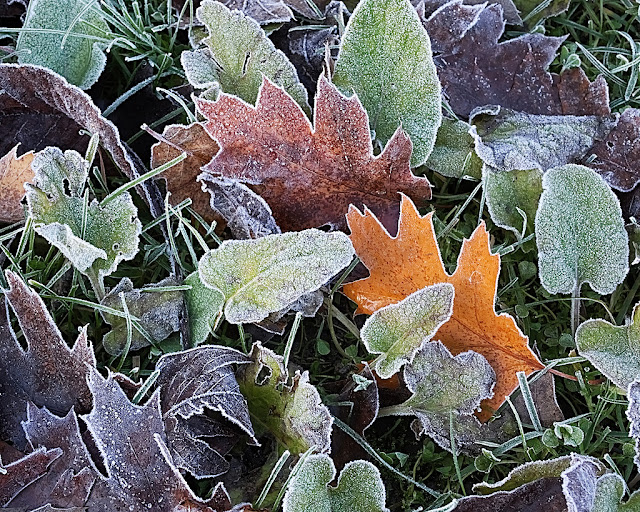

Dead leaves, mostly oak, coloured from orange to dark brown amongst grass and low growing plants
Fallen Leaves - 8 November 2016
Most of the colour of dead leaves derives from the breakdown of chlorophyll
unmasking yellow and orange pigments already present.

The process by which a living green leaf, producing sugar and oxygen from sunlight and air, turns bright red or yellow, and eventually falls to earth and rots away, starts when the length of the night exceeds a certain value. The tree then builds a barrier between the leaf and the rest of the tree, cutting the leaf off from nutrients absorbed through the roots, and tree from the sugar created in the leaf. As a result the green chlorophyll pigment decays, and exposes the yellow and orange colours of the xanthophylls and carotenoids normally present in the leaf. 
 

Red maple leaf with yellow and brown leaves
Maple Leaves - 8 November 2016
Red pigmentation develops after the leaf is already dying.
What is the advantage to the tree?

Interestingly, the red colours come from a third group of pigments, the anthocyanins, which are only synthesised when the leaf is dying. It is not entirely clear what the advantage to the tree is to have red leaves in autumn. Theories include: to warn off aphids which might want to use the tree as an overwinter host; to undermine the camouflage of herbivores; or, to attract birds to the tree to eat berries which may otherwise be overlooked. The anthocyanins in maple leaves have been shown to stunt the growth of any nearby saplings.

The Weather For It


The best display of autumn colour is produced when a moist growing season is followed by a dry autumn with sunny days and cool, but not frosty nights. Heavy rain, gales and frost are all likely to bring a premature end to the display.


Folklore, Legend and Medicine
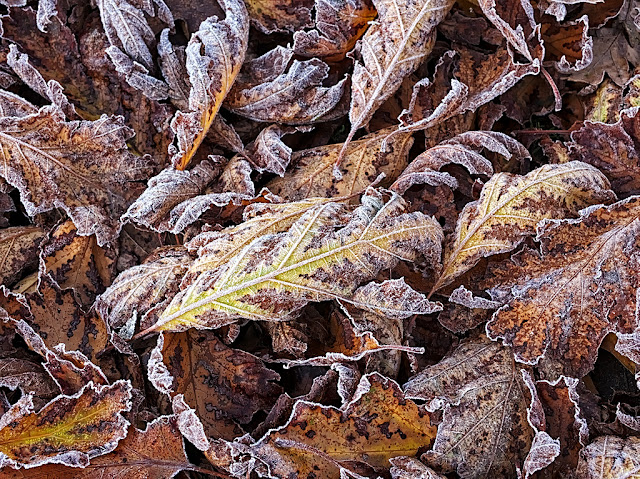


Blanket of oak leaves in various shades of brown
Oak Leaves - 8 November 2016
With a mass of leaves like this, it is easy to see why the Lakota believed
they had been dropped as a protective blanket.

Fallen leaves, though such a prominent feature of the countryside in their season, do not feature greatly in folklore. They have been associated with fairies, with a swirl of leaves believed to be evidence of fairies dancing. Catching a falling leaf, particularly at the beginning of autumn, is said to protect the catcher from illness, or, more specifically, colds, throughout the winter.

But, perhaps, the most charming legend is that of the Lakota American Indians. The god who looks after living creatures saw the suffering of the plants and flowers as they shivered in the increasing cold of Autumn. Feeling sorry for them, the deity ordained that the trees should shed their leaves over the earth as a blanket to keep the plants warm. In return, the trees were allowed one great last blaze of glory.

I could find no reference to any medicinal use of fallen leaves.  However,  a Finnish company is developing the technology to extract natural pigments from the leaves for use in the clothing and cosmetic industries. The residual biomass is high in nutrients with possible uses as a fertiliser.

Next: More Autumn 


Saturday, 26 November 2016

Autumn 2016

Oak and maple trees turning yellow
The Golden Season - 8 November 2016
Autumn in golden in Milton Country Park
Here the trees in Remembrance Meadow are all turning yellow

Autumn is nature's siren, using its beauty to lure us into the misery of winter.  It is living proof that you can say anything with a smile on your face: this attractive season of reds and yellows presages nothing but wind, rain, snow, ice and darkness.  Yet we love it!  It is a beautiful woman with a dagger behind her back.

A stand of poplar trees shine yellow backlit by the morning sun
Poplar Trees Catch the Morning Sun - 2 November 2016
Poplars are one of the first trees to change colour
Here a group shine gold in the morning sun.

And why are we so keen to see the back of green leaves?  Admittedly, by October the green has become rather dull and tired, the flowers, except for a few stragglers, have gone, and the countryside is generally untidy.  But the green is the green of chlorophyll, and without chlorophyll there would be no oxygen, and with no oxygen, we could not live.  

Oak tree with a canopy of copper leaves
  • 'Copper' Oak - 18 November 2016
  • This oak catches the eye with its copper coloured leaves
  • In mid-November, the oaks are perhaps the most colourful trees in the park

Autumn is famously the season of 'mists and mellow fruitfulness'.  It may be climate change, but mists have been very few and far between in the eighteen of so months I have been writing this blog. Similarly, by mid-autumn most of the apples, plums and pears have disappeared from the trees and bushes.  Though, in a mild autumn like this one, there are still a lot of hawthorn berries on the bushes.  Presumably, the birds have been able to find plenty of food elsewhere.  


Branches of hawthorn bush covered in red berries
A Winter Larder - 18 November 2016
With a mild autumn, there are still plenty of berries of the bushes for the birds when they need them


The photographs for this post have all been taken in the first half of November.  At this time, while the poplars and the sycamores have turned yellow, there are still some trees and bushes that have barely changed colour at all: the willows and brambles are still quite green.  In contrast, one oak tree in Remembrance Meadow has lost all but a couple of its leaves; an early reminder of what is to come.


Oak tree with only one clump of leaves left on the branches
Goodbye to Summer - 8 November 2016
Last few leaves left hanging on this oak tree, yet still only early November 


In contrast, these willow trees on the banks of Todd's Pit were taken just two days earlier:

Willows along the bank of Todd's Pit with green leaves and red branches
  • Willow Bank - 6 November 2016
  • Still plenty of green leaves on these willow trees on the bank of Todd's Pit
Next: Autumn Leaves 2016


Saturday, 12 November 2016

Reeds

Single reed plant framed by bushes
Deep Pool - 3 July 2016
Single reeds have a simple elegance.

This project to document Milton Country Park through the year is based on three assumptions. 

Firstly, I believe that any natural, or semi natural environment, not matter how ordinary, banal, or familiar it may seem, is worthy of attention.  

Secondly, any semi natural environment (there are very few truly natural environments left in England) is to be valued for what it offers, and not dismissed because of its lack of dramatic scenery, or noteworthy and endangered plants and animals.  For most people, more exotic and dramatic locations bring excitement for perhaps a fortnight a year; it is in the local neighbourhood that one can enjoy nature for the other 300 odd days a year.

Thirdly, that a photographer with sufficient skill and imagination, and given the right conditions, should be able to produce interesting, if not beautiful images of such places.  Edward Weston's pictures of Port Lobos and Eliot Porter's intimate landscapes of New England have been particularly inspirational to me.

A small group of flower heads of the common reed backlit by the morning sun
Wetlands - 11 September 2016
Flower heads of the common reed shine in the early morning sun


This brings me to the subject of this week's post: reeds (I use the word loosely for any plant that that has lanceolate leaves and grows by the water).  I admit that I find these plants neither interesting nor visually  appealing.  A search on the net did not unearth any particularly interesting facts: no witches, fairies, goblins, spells or miracle cures; just practical uses in thatching, water cleansing and floor covering for churches.  So, in many ways, to write a post on the subject of reeds illustrated with interesting photographs is a good test of the ideas I outlined above.


Dickerson's Pit at sunset with reeds in the foreground
Dickerson's Pit - 3 August 2016
Reeds are important to the appearance of the park


But reeds are important both to the ecology and to the appearance of the park. With over 2000 metres of water's edge to colonise, plus the majority of the wetland area, there are a lot of reeds in Milton Country Park. 


Close up of flower head of soft rush
Soft Rush - 26 June 2016

Visually, isolated plants have a certain elegance as shown in the image at the top of this post.  With back lighting, the flower heads of the common reed are a dramatic sight.  And in the fading evening light, I found the semi-circle of circle of rushes in shallow water just away from the bank made an attractive scene.  


Branched bur reed in bed of other reeds
Branched Bur Weed - 7 July 2016


As mentioned above, I have used the term 'reed' very loosely.  I now recognise there are at least five different plants involved. The commonest of which are the common reed, Phragmites australis; the soft rush, Juncus effusus; and yellow irises, Iris pseudocaris.  The latter is definitely not a reed, but included here because of the shape of its leaves.


Close up of flower of greater spearwort
Greater Spearwort - 7 Jully 2016


In one small inlet off Dickerson's Pit, I found two other plants.  One was branched bur-reed, Spharganium erectum, which looks like a model of a chemical formula found in a schools science laboratory.  In the same short stretch, I was surprised by some large yellow flowers among the reeds, which on investigation proved to be greater spearwort, Ranunculus lingua.

I certainly have not unearthed any earth shattering facts or created world beating photographs, but what I have found and the images I have made do nothing to dissuade me that even the most unpromising material is worth close attention. 

Saturday, 22 October 2016

Clematis and Hawthorn

This is the second post about fruits and berries in Milton Country Park.

Clematis 


Bank of fruiting clematis
Clematis vitalba - 21 September 2016
Its similarity to an old man's beard is striking

Clematis vitalba has colonised a number of the trees and bushes in the north of the park.  In many cases, the climber has completely swamped its host, and, as in this picture, very little of the supporting tree or bush is visible, behind a bank of the invader.  The appropriateness of its common name, old man's beard, is very obvious when a mass of its seed heads like this are seen.


Tree covered in flowering clematis
Flowering clematis - 31 July 2016
Tree completely covered in clematis flowers.

This plant is also commonly known as traveller's joy. This name, that has been in use since at least the 16th Century, refers to the bright and cheerful display its seeds make during the sombre autumn months.  Although small greeny white flowers are quite showy, they do not have the impact of later fruit.  


Close up of clematis flowers
Clematis flowers - 24 July 2016
The flowers are unusual in that they have no petals.

The most unusual feature of the flowers is that they have no petals; the petal like structure that can be seen in this picture are sepals.  Maybe not that surprising in the wild plants, but, far more so in the cultivated plants with their huge multicoloured sepals.


Fruiting clematis and brambles
Clematis and brambles - 12 September 2016
Like scavengers fighting over a corpse, brambles and clematis vie for dominance

One of the things I have become increasingly interested in is plant communities and how plants compete for space and light.  In this picture, it is hard to know what is buried below the smothering mass of brambles and clematis.


Hawthorn


Clematis with fruit climbing around hawthorn full of red berries
Clematis and hawthorn - 11 September 2016
Contrasting seeds of hawthorn and clematis

Given the number of hawthorn bushes in the park, it is not surprising that some have been invaded by clematis.  I found the contrast of the small dense berries of the hawthorn and the fluffy white seeds of the clematis quite striking.


Hawthorn bush with masses of red berries
Hawthorn - 12 September 2016
Hawthorn bush with a good crop of berries


What a difference a year makes!  Last year, I worked hard to find any hawthorn bush with more than a few berries.  This year, every bush, like the one in this picture, was laden with them.

Rose Hips


Arching briar with rose hips
Rose Hips - 12 September 2016
Easily missed amongst the mass of hawthorn berries

Almost totally lost amongst all the millions of hawthorn berries in the park are few dog roses with their bright orange red hips. I spotted these on a bush at the north of the park.


I was surprised how little folk lore and herbal medicine is attached to this plant. Its medicinal use seems to be confined to use as a source of vitamins, particularly vitamin C, when a syrup is made from the hips.


Perhaps, the most intriguing bit of folk lore I came across is the Indian belief that if fairies ate rose hips and turned three times counter clockwise, they became invisible. Eat the rose hips again, and turn three times clockwise, and, hey presto, the fairies become visible again.


The rose has also been a symbol of silence since the early Egyptians. Any matters discussed under a rose were in strict confidence. This led to the custom of carving roses on the ceiling of banquetting halls to remind guests that any conversations were not to be repeated outside of the hall.

Next: Reeds


Saturday, 8 October 2016

Apples and Plums

Photographing Milton Country Park for the second year running has given me the opportunity to either picture things I missed the first time around, or, hopefully, improve on my images from last year. As anyone who has photographed in the same place for any length of time will know, seasons vary tremendously from year to year.

Cherry Plums 


Tree laden with cluster of ripe cherry plums
Cherry Plums - 31 July 2016
A bumper crop this year


The mild spring and the warm and wet summer has meant a bumper crop of cherry plums. Last year, I took some pictures at an early stage when just a few plums were ripe. When I went back later, they had all disappeared. This year, to avoid the same mistake, I assiduously photographed the plums twice a week for three weeks. But I needn't have worried, as the trees were laden with fruit as the image above shows. This is far more than last year. Interestingly, the plum trees in the orchard had far fewer plums than in 2015.

Lords and Ladies


Spikes of ripe but uneaten lords and ladies among bramble and ivy
Lords and Ladies - 7 August 2016
A clump of ripe but uneaten fruit among the brambles and the ivy

Another fruit I struggled to capture last year, was the bright red berries of cuckoo pint (for some reason I think of the plant as cuckoo pint, and its fruit as lords and ladies). In 2015, all the spikes seem to be eaten as soon as they appeared. This time around, I had no problem in finding entire spikes, like the group shown here. Is this a reflection of an increase in number of berries, or that the birds, squirrels, and rabbits had plenty of other things to eat?

Apples


Bunches of ripening apples in closeup
Ripening Apples - 28 August 2016
They may not be the forbidden fruit but their temptation is obvious

It appears that it has been a bumper year for apples as well. This cluster of large, juicy fruit was typical of all the apple trees I saw in the park. Fruit such as this make it easy to understand why the apple has become associated with the forbidden fruit in the tale of Adam and Eve and their expulsion from Eden. But the Bible does not the name the forbidden fruit, and its identity with the apple is more a product of the imagination of Renaissance painters. In fact, some would argue that the forbidden fruit could not have been an apple as it would not have been found in the Middle East at the time. However, this argument seems specious as the ecology of the surrounding countryside is generally irrelevant to the contents of a garden, particularly a paradise like Eden – just think of all the non-native plants found in modern day Eden Project in Cornwall.

Apple tree with apples shining in the early morning sunshine
In the Orchard - 28 August 2016
Apples gleam in the early morning sunshine

There is the old saying that you can't see the wood for the trees; but when it comes to photographing apples in the orchard, it seemed more a case that the camera couldn't see the fruit for the trees. I finally settled on this picture where the apples reflect the low sunlight more strongly than the surrounding leaves and stand out just that little bit.


Branches of apples laden with apples against the sky
Overhanging the path - 25 August 2016
Why is it that the best fruit is always out of reach?

In both these cases, the apples were green. On the higher boughs, where they got more sunlight, they were already turning a mouth watering red.

Apples are of course healthy. We have all heard the saying 'an apple a day keeps the doctor away', but the list of diseases the apple has been thought to cure is truly impressive, including: constipation, gout, fatigue, rheumatism, problems with the kidney or liver, anaemia and urine retention. It is said to lower cholesterol; and rubbing two halves of a sliced apple on a wart, then burying the remainder, eliminates the wart. No wonder the apple is associated with immortality.

Horse Chestnut


Small horse chestnut tree with conkers
Young Horse Chestnut - 28 August 2016
Conkers clearly visible on this tree which so far has escaped the ravages of the leaf miner

One of the newly planted horse chestnut trees in the south of the park produced a nice crop of 'conkers', which inevitably led to my wondering why they are called conkers. The most likely explanation is they are named after the game of conquerors, which was originally played with snail shells or hazel nuts. Wikipedia lists the wonderful obblyonkers as a regional alternative name.

Fruitless


Racemes of greeny white hop flowers
Male Hops - 21 August 2016
I have so far been unable to find any female plants with hops

I end this post with the fruit I didn't find. At the north end of the park by the Fen Road exit, I noticed a couple of trees covered with a large leafed climber with whitish-green flowers in panicles. As far as I can tell these climbers of male hop plants, and so far I have been unable to locate any female plants bearing the familiar hops anywhere in the park.

Next: Clematis and Hawthorn