a
I am taking a short break from writing this blog, partly because I don't have the time at the moment, and partly because I am unsure of the future direction of the blog. I feel that after two and a half years, I have thoroughly documented Milton Country Park, and don't necessarily think I have any more to say.
In fact, I was thinking of stopping the blog altogether until yesterday morning, when I took the dog for a walk around the park. Everything was bathed in a light mist, enough to obscure, but not thick enough to obliterate. I found the light inspirational, particularly as the moist air deadened the sound of traffic on the nearby dual carriageway. Unfortunately I didn't have a camera with me, as the dog is at an age where she demands too much attention.
Looking across Dickerson's Pit, I could see the shapes of the trees on the far bank, but the details had gone, and the colour was drained from the leaves. On the water, a couple of swans and a few seagulls loomed preternaturally large and white in the mist. On the ground, the leaves that had been ripped off the willows in the recent wind were rotting down to a mosaic of yellows, browns, purples and reds, turning the water of any puddles that had formed on top of them a light orange-red colour.
Everywhere I looked, I could see potential shots: bright yellow maple leaves which had fallen between sinuous dark tree roots; a forked tree overlooking the water; a clump of toadstools at the base of an old ivy covered willow; and a new view that had been opened up from the north end of Hall's Pond.
This has persuaded me to continue. The challenge is clearly greater, as I have already photographed the more obvious spots. But looking at the works of Edward Weston, Paul Strand, and Minor White, I am very tempted to seriously try some black and white photography, with its emphasis on tonality and form. And this is what I will be doing in my next post, hopefully, within the next month.
Showing posts with label Maples. Show all posts
Friday, 20 October 2017
Saturday, 27 May 2017
Unfolding Spring
Spring. As the sun moves nearer the equator, the days get longer and warmer. On the trees, new leaves and flowers burst out of the buds which have been dormant during the winter. The countryside is transformed from a dull monotone to a celebration of vibrant greens.
In the past two years, I have tried to capture the landscape of the park at the tipping point when the trees first begin to turn green, with results that have not been wholly convincing. This year, I have photographed individual buds as they unfurl.
In February, the trees are drab, brown and bare, hide nothing. The opposite bank of Dickerson's Pit is clearly visible across the water from the path that runs alongside the eastern border of the park. By June, the trees are completely covered with leaves, whose colours range from the willow's silvery green, through the red green of the sycamore, to the bright saturated colours of the hawthorn, and which form an almost impenetrable screen between the waters of the pit and the visitor.
But the change is gradual, and like all gradual changes, it isn't noticed, particularly since it is punctuated by tidal waves of white spring blossom. How late would the leaves have to appear before anyone remarked on the delay? For instance, imagine if the winter was very cold and extended so that the trees were still bare in June, would anyone talk about the lack of leaves, or would they discuss how late the hawthorn flowers were?
Neither is it a single monolithic process, but a whole series of changes as each tree species gets its leaves at different times. It starts with the elder in February; this is followed by the sycamore, then the hawthorn; and, finally, in May, the beech and the poplar. As far as I can find out, only the relative timing of the appearance of the leaves of the ash and the oak has made it into weather lore:
Ash before Oak - we're in for a soak,
Oak before Ash - we're in for a splash
Perhaps the one bud everyone knows is the sticky bud, the large bud of the horse chestnut which is covered in a sticky resin. The resin serves a dual purpose, it protects the bud from frost and water damage, and also against attack by small insects. As the day temperatures rise, the resin melts and very quickly the large palmate leaves unfurl.
Close scrutiny of a developing bud reveals it is far from a simple case of a single leaf emerging from a single bud. Take, for instance, this picture of a developing hawthorn bud. There is clearly a rosette of leaves, inside of which are the flower buds. All tightly packed together in the minimum possible space. If this were the end product, we would admire it. As it is only a short lived stage in the development of the anticipated flower, it is ignored.
But beyond a masterpiece of packaging engineering, consider what a photograph cannot show. Each new cell that is created has the same DNA, and therefore the same potential, as every other cell in the whole tree. What controls how any particular cell develops? What determines whether it becomes part of the fabric of the leaf, part of a vein, or part of a petal?
Further Reading
Aesculus hippocastaneum
Horse Chestnut
Next: Catkins
![]() |
| Young Sycamore - 24 March 2017 Sycamore are amongst the first trees to get their leaves. Here at the end of March the new leaves shine in the spring sunshine. |
In the past two years, I have tried to capture the landscape of the park at the tipping point when the trees first begin to turn green, with results that have not been wholly convincing. This year, I have photographed individual buds as they unfurl.
![]() |
| Field Maple - 26 March 2017 Field maple is one of the dominant shrubs in the park. Their new yellow/green leaves give the park a springlike feel. |
In February, the trees are drab, brown and bare, hide nothing. The opposite bank of Dickerson's Pit is clearly visible across the water from the path that runs alongside the eastern border of the park. By June, the trees are completely covered with leaves, whose colours range from the willow's silvery green, through the red green of the sycamore, to the bright saturated colours of the hawthorn, and which form an almost impenetrable screen between the waters of the pit and the visitor.
![]() |
| Bramble - 26 March 2017 There is plenty of new growth on the brambles, but plenty of last year's leaves are still in evidence. |
But the change is gradual, and like all gradual changes, it isn't noticed, particularly since it is punctuated by tidal waves of white spring blossom. How late would the leaves have to appear before anyone remarked on the delay? For instance, imagine if the winter was very cold and extended so that the trees were still bare in June, would anyone talk about the lack of leaves, or would they discuss how late the hawthorn flowers were?
![]() | |
| Oak - 23 April Oak are one of the last trees to get their leaves. This was one of the oak trees on remembrance meadow. |
Neither is it a single monolithic process, but a whole series of changes as each tree species gets its leaves at different times. It starts with the elder in February; this is followed by the sycamore, then the hawthorn; and, finally, in May, the beech and the poplar. As far as I can find out, only the relative timing of the appearance of the leaves of the ash and the oak has made it into weather lore:
Ash before Oak - we're in for a soak,
Oak before Ash - we're in for a splash
![]() |
| Horse Chestnut - 26 March 2017 The unmistakeable sticky bud of the horse chestnut on one of the newly planted chestnut trees at the south end of the park. |
Perhaps the one bud everyone knows is the sticky bud, the large bud of the horse chestnut which is covered in a sticky resin. The resin serves a dual purpose, it protects the bud from frost and water damage, and also against attack by small insects. As the day temperatures rise, the resin melts and very quickly the large palmate leaves unfurl.
![]() | |
| Unfolding Hawthorn Bud - 26 March 2017 Close up of bud shows emerging flower buds amongst the unfolding leaves |
Close scrutiny of a developing bud reveals it is far from a simple case of a single leaf emerging from a single bud. Take, for instance, this picture of a developing hawthorn bud. There is clearly a rosette of leaves, inside of which are the flower buds. All tightly packed together in the minimum possible space. If this were the end product, we would admire it. As it is only a short lived stage in the development of the anticipated flower, it is ignored.
But beyond a masterpiece of packaging engineering, consider what a photograph cannot show. Each new cell that is created has the same DNA, and therefore the same potential, as every other cell in the whole tree. What controls how any particular cell develops? What determines whether it becomes part of the fabric of the leaf, part of a vein, or part of a petal?
Further Reading
Aesculus hippocastaneum
Horse Chestnut
Next: Catkins
Labels:
Ash,
Beech,
Bramble,
Buds,
Dickerson's Pit,
DNA,
Hawthorn,
Horse Chestnut,
Maples,
Oaks,
Poplars,
Spring,
Sticky Buds,
Sycamore
Saturday, 10 December 2016
Autumn Leaves 2016
![]() |
| Poplar Leaves - 2 November 2016 When on the tree, the yellow and red leaves would have been admired; on the ground, the range of colours is actually increased. |
We all admire the brilliantly coloured leaves of autumn while they are still on the tree. But when they fall off the tree, onto the ground, our attitude changes; their beauty is forgotten and we see them only as a nuisance. They make our streets and gardens untidy; they block the drains; and, they form a slippery layer on the railway lines, stopping the trains running to time. All that is left is to collect them up, and either burn them or put them in the rubbish; except for gardeners, who use the dead leaves for compost.
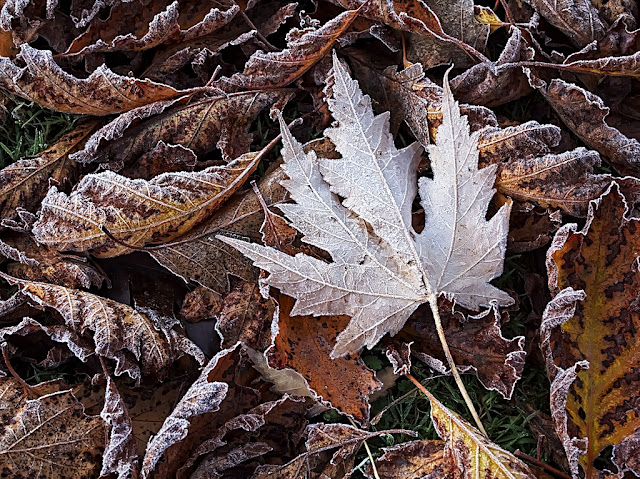
![]() |
| Contrasting Leaves - 8 November 2016 The maple leaf contrasts strongly with the surrounding oak leaves in colour, shape and texture. |
But there is still plenty of visual interest in the leaves as they rot away on the ground. While the vibrant colours remain for a few days at least after the leaves have fallen, the range of colours is increased, not only by browns, dark purples, and blacks of the decomposing leaves, but also by different coloured leaves from adjacent trees. Similarly, there are strong contrasts in shape and texture when a leaf from one tree falls on the leaves from a different type of tree.
Why Leaves Turn Red and Yellow
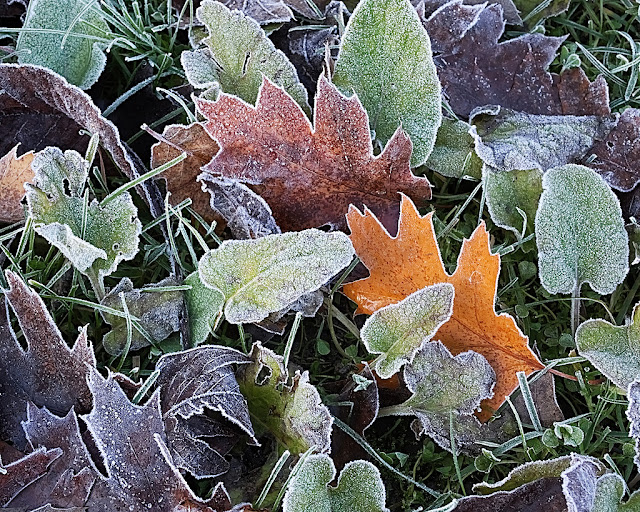
![]() |
Most of the colour of dead leaves derives from the breakdown of chlorophyll unmasking yellow and orange pigments already present. |
The process by which a living green leaf, producing sugar and oxygen from sunlight and air, turns bright red or yellow, and eventually falls to earth and rots away, starts when the length of the night exceeds a certain value. The tree then builds a barrier between the leaf and the rest of the tree, cutting the leaf off from nutrients absorbed through the roots, and tree from the sugar created in the leaf. As a result the green chlorophyll pigment decays, and exposes the yellow and orange colours of the xanthophylls and carotenoids normally present in the leaf.
![]() |
| Maple Leaves - 8 November 2016 Red pigmentation develops after the leaf is already dying. What is the advantage to the tree? |
Interestingly,
the red colours come from a third group of pigments, the
anthocyanins, which are only synthesised when the leaf is dying. It
is not entirely clear what the advantage to the tree is to have red
leaves in autumn. Theories include: to warn off aphids which might
want to use the tree as an overwinter host; to undermine the
camouflage of herbivores; or, to attract birds to the tree to eat
berries which may otherwise be overlooked. The anthocyanins in maple
leaves have been shown to stunt the growth of any nearby saplings.
The Weather For It
The
best display of autumn colour is produced when a moist growing season
is followed by a dry autumn with sunny days and cool, but not frosty
nights. Heavy rain, gales and frost are all likely to bring a
premature end to the display.
Folklore, Legend and Medicine
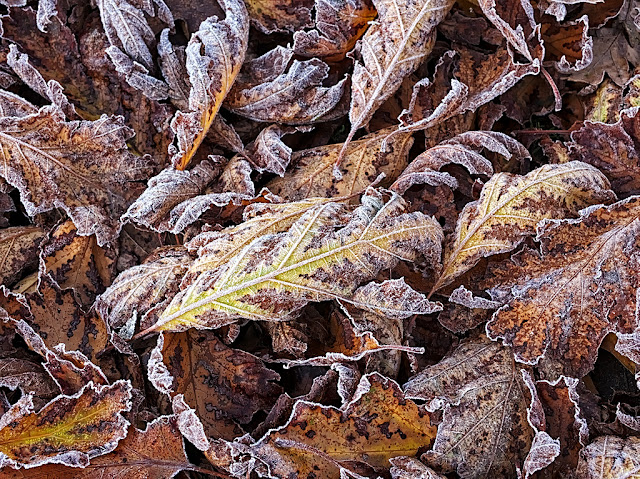
![]() |
| Oak Leaves - 8 November 2016 With a mass of leaves like this, it is easy to see why the Lakota believed they had been dropped as a protective blanket. |
Fallen
leaves, though such a prominent feature of the countryside in their
season, do not feature greatly in folklore. They have been
associated with fairies, with a swirl of leaves believed to be
evidence of fairies dancing. Catching a falling leaf, particularly
at the beginning of autumn, is said to protect the catcher from
illness, or, more specifically, colds, throughout the winter.
But,
perhaps, the most charming legend is that of the Lakota American
Indians. The god who looks after living creatures saw the suffering
of the plants and flowers as they shivered in the increasing cold of
Autumn. Feeling sorry for them, the deity ordained that the trees
should shed their leaves over the earth as a blanket to keep the
plants warm. In return, the trees were allowed one great last blaze
of glory.
I could find no reference to any medicinal use of fallen leaves. However, a Finnish company is developing the technology to extract natural pigments from the leaves for use in the clothing and cosmetic industries. The residual biomass is high in nutrients with possible uses as a fertiliser.
Next: More Autumn
I could find no reference to any medicinal use of fallen leaves. However, a Finnish company is developing the technology to extract natural pigments from the leaves for use in the clothing and cosmetic industries. The residual biomass is high in nutrients with possible uses as a fertiliser.
Next: More Autumn
Saturday, 26 November 2016
Autumn 2016
![]() |
| The Golden Season - 8 November 2016 Autumn in golden in Milton Country Park Here the trees in Remembrance Meadow are all turning yellow |
Autumn is nature's siren, using its beauty to lure us into the misery of winter. It is living proof that you can say anything with a smile on your face: this attractive season of reds and yellows presages nothing but wind, rain, snow, ice and darkness. Yet we love it! It is a beautiful woman with a dagger behind her back.
![]() |
| Poplar Trees Catch the Morning Sun - 2 November 2016 Poplars are one of the first trees to change colour Here a group shine gold in the morning sun. |
And why are we so keen to see the back of green leaves? Admittedly, by October the green has become rather dull and tired, the flowers, except for a few stragglers, have gone, and the countryside is generally untidy. But the green is the green of chlorophyll, and without chlorophyll there would be no oxygen, and with no oxygen, we could not live.
![]() |
|
Autumn is famously the season of 'mists and mellow fruitfulness'. It may be climate change, but mists have been very few and far between in the eighteen of so months I have been writing this blog. Similarly, by mid-autumn most of the apples, plums and pears have disappeared from the trees and bushes. Though, in a mild autumn like this one, there are still a lot of hawthorn berries on the bushes. Presumably, the birds have been able to find plenty of food elsewhere.
![]() |
| A Winter Larder - 18 November 2016 With a mild autumn, there are still plenty of berries of the bushes for the birds when they need them |
The photographs for this post have all been taken in the first half of November. At this time, while the poplars and the sycamores have turned yellow, there are still some trees and bushes that have barely changed colour at all: the willows and brambles are still quite green. In contrast, one oak tree in Remembrance Meadow has lost all but a couple of its leaves; an early reminder of what is to come.
![]() | ||
| Goodbye to Summer - 8 November 2016 Last few leaves left hanging on this oak tree, yet still only early November |
In contrast, these willow trees on the banks of Todd's Pit were taken just two days earlier:
![]() |
|
Subscribe to:
Posts (Atom)


